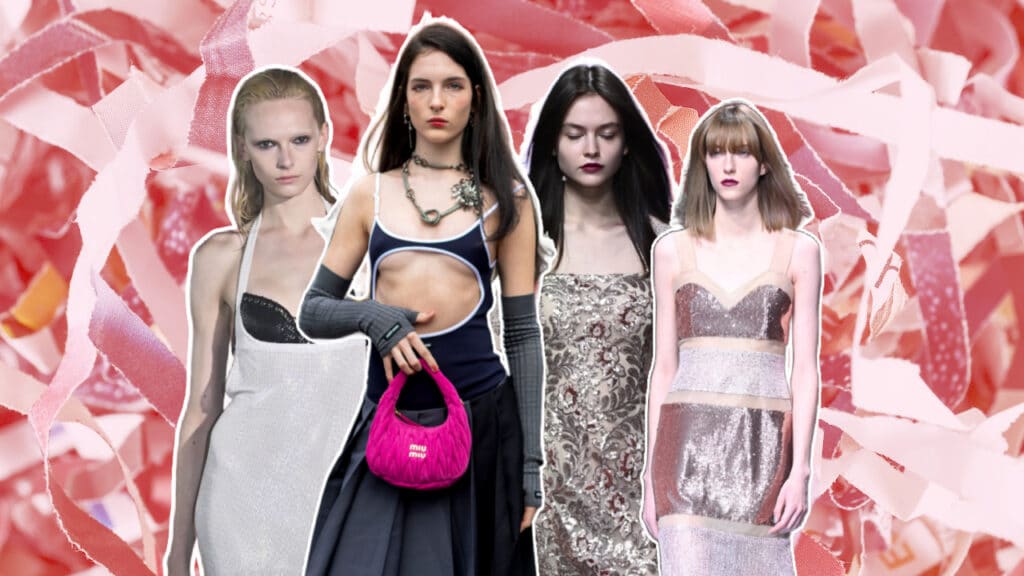
Is the Body Inclusivity Era Ending? Thinness and Conservative Beauty Are “Back”
Some call it the “end” of the body positivity era. Others frame it as the rise of conservative beauty standards. Those who grew up through the 2000s’ obsession with thinness identify a pattern: “ultra skinny is back.”
Alongside the billboards promoting “unhealthily thin” bodies and celebrities’ obsession with GLP-1 drugs, terms like Mar-a-Lago face, Republican makeup, and MAGA beauty have slowly infiltrated beauty conversations.
The rise of new beauty standards for women
It was subtle at first. The swift period when industries and pop culture entertained the notion of body inclusivity waned slowly. Unattainable thinness crept back into the mainstream almost imperceptibly. Then, the world saw the rise of ultra-gendered aesthetics and hyperfeminine beauty.
In 2025, however, the seismic shift in beauty is impossible to overlook. In February, Vogue reported one of the “lowest size inclusivity figures” since the launch of its size inclusivity report. Across fashion capitals, plus-size models made up only 0.3 per cent of the Fall-Winter 2025 runway casting. The figure may not say much, given that the industry, by default, thrives on a system of exclusion. However, just a couple of seasons ago, the percentage of plus-size models had reached 0.9 per cent. The decline is hard to miss.
In pop culture, celebrities have made Ozempic a coveted solution for rapid weight loss. The debate opened when even those who made a name for challenging traditional beauty ideals and championing “larger bodies” celebrated weight loss.
Then came the popularisation of what many have described as “over-the-top” and artificial beauty. Young influencers and various political figures from the Trump administration exemplify it. Dubbed “Mar-a-Lago face” for its resemblance to the preferred South Florida look, the look embodies cosmetic enhancement taken to the extreme. Think of injectables, puffy lips, cheek implants, unnaturally bronzed skin, ultra-long lashes, and heavy makeup.
Is beauty a tool for political control?
In an era of diversity cutbacks and racially-charged narratives, the return of skinny body ideals and artificial beauty goes beyond surface-level aesthetics. The growing consensus among connoisseurs and academia is that this “backslide” in beauty is directly tied to the rise of political conservatism.
“This isn’t just cosmetic—it’s cultural currency,” writes the Naderi Centre for Plastic Surgery & Dermatology on their website. “This look wasn’t inherited. It was strategically built.”
Gender Perspective Psychologist Elia Paulina González says it’s no coincidence that beauty ideals are hard to achieve. “Unattainable beauty isn’t an aesthetic accident; it’s the perfect strategy for social control,” she tells FIERCE. “From a feminist psychology perspective, we explain this as pure control and surveillance. Conforming to an ideal created by men—patriarchal societies—guarantees that women, who grew up in that environment, adopt that ideology without question.”
González argues that fueling women’s insecurities or encouraging them to focus on the physical realm is beneficial for patriarchal-capitalist societies. “It’s a system designed to make us forget our true place in society. Have you ever thought about all the time and money you invest in meeting a beauty standard? Imagine if we invested that in our businesses, in politics, the environment, or security.”
Beauty standards as a getaway for marginalisation
But unreal body ideals not only seek to exert control over women’s bodies. They also create space for marginalisation and encourage white supremacist rhetoric. Slenderness, for example, has been historically equated with whiteness, says Dr Freya Gowrley, senior lecturer in History of Art and Liberal Arts at the University of Bristol. “It’s understood by some as an inherently good thing—a physical state that reflects perceived white supremacy in racist rhetoric,” she tells FIERCE.
As Gowrley explains, scholars such as Sabrina Strings have explored fatphobia as an intersectional form of discrimination influenced by racism. Strings’ Fearing the Black Body dives into the racial origins of fatphobia, linking Blackness and fatness—both regarded as “inferiorities in the colonial imagination.”
“As a radical, inclusive movement, [body positivity] often highlights experiences of queer and differently abled folk,” says Gowrley. “[The return of thin standards] is a rejection of diversity, and so inherently a political shift. As such, it reflects a general rightward turn in popular culture, which we also see in the rise of [movements] like the tradwife influencer, or the Sydney Sweeney advert.”
Does anyone benefit from the resurgence of thinness and artificial beauty as standards?
“I think the naturally very skinny, whose bodies are also fiercely critiqued in the rhetoric around the ‘perfect’ body, could benefit from a shifting normalisation,” says Gowrley. “But beyond that, no. The pressures that [the return of skinny ideals] is already causing to lose weight that was until recently accepted and celebrated is only a bad thing.”
Women, particularly women of color and marginalised communities, certainly won’t benefit from a societal climate that makes them feel inadequate and lacking. However, the big winners will be industries, argue culture commentators and experts.
“If a happy consumer is indeed a bad consumer, the inferiorized woman is more valuable than gold in today’s America,” wrote Substack personality Father Karine in a viral post titled “The Anti-Cosmetic Surgery Essay Every Woman Should Read.”
“Once we are infected with the disease (the belief that our bodies are deficient and must be improved), we can be sold the cure,” the writer added. “The antidote for our inferiorized bodies is a never-ending slew of cosmetic surgery, makeup, serums, cleansers, pharmaceuticals, moisturizers, spray tans, cosmetic dentistry, hair masques, hair removal, manicures, facials, the list goes on.”
González resonates with the idea. “Women’s insecurity is profitable for this patriarchal-capitalist world. Unfortunately, body dysmorphia, self-imposed pressure, and feelings of inadequacy are lucrative,” she says. “All this suffering fuels the ‘beauty’ market, diets, surgeries, and the wellness industry.”
Constant exposure to unrealistic standards fragments and disturbs women, adds González. “It’s as if women learn that they are inherently flawed or insufficient,” the psychologist says. “This leads to a fragmented self-concept and is the breeding ground for serious clinical disorders such as Body Dysmorphic Disorder and Eating Disorders (EDs) like anorexia and bulimia.”
So what can women do when society keeps shoving beauty narratives our way?
“We need to be critical and strategic to avoid internalizing the pressure of unattainable beauty, ” says González. As she puts it, putting the brakes on our bodies is the first political act.
González recommends critical consumption and self-care to dismantle pressure. A great first step, particularly on social media, is toning down the rhetoric around body image, weight, or food. González also suggests reclaiming the discourse. She encourages women to value and name aspects of their personality that are not physical. Instead, these valuable assets can be tied to intellect, authenticity, creativity, ethics, passion, or emotional intelligence.
But above it all, González says, it’s time to recognize systemic violence that portrays women’s appearance as the real problem. “Collective healing begins when we understand that the symptom, those emotional or mental pains, are not the problem,” she explains. “They are just an alarm telling us: you are experiencing systemic violence.”
The good news? “Just as today we question whether we are ashamed to have a boyfriend, we can question whether we should continue investing our energy in the project of the ‘perfect body’.”