Why Is No One Vibing With Pantone’s Pick for 2026, And Why Does It Hit So Wrong?
No one is vibing to Pantone Color of the Year 2026, “Cloud Dancer,” aka white. The reason goes beyond mere aesthetics. For color, social and political experts, as well as the general public, the choice has come across as tone-deaf, boring, and flavorless, at best. At worst, Pantone’s color selection is ruffling feathers for its political and social implications. Especially in a year marked by eugenics discourse, DEI cutbacks, and anti-immigrant policies.
Cloud Dancer is the color of 2026
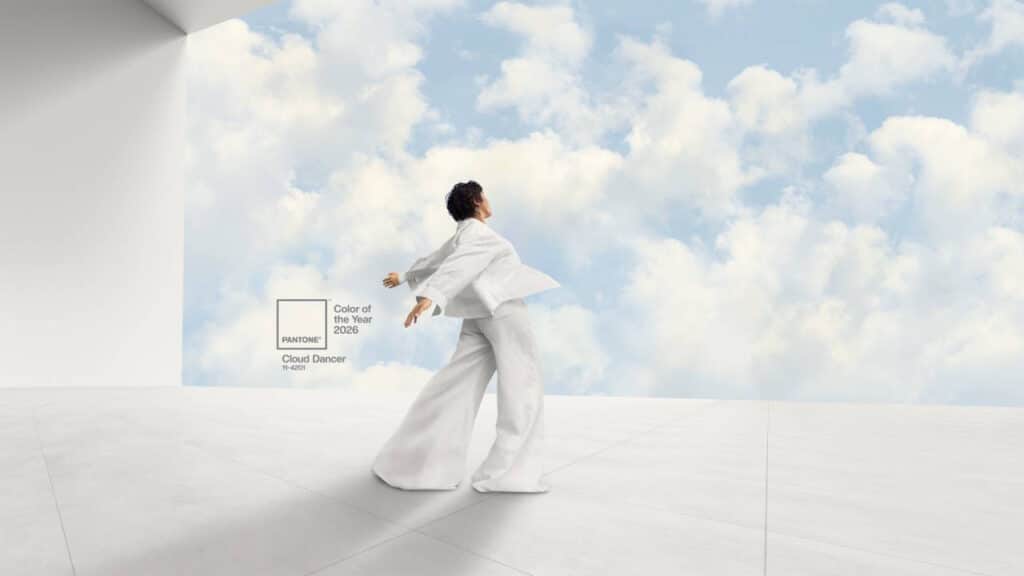
Since 1999, Pantone, the color standard-setting institution, has unveiled its Color of the Year predictions for the New Year. This December, for the first time in 26 years, the company selected a white-adjacent tone titled “Cloud Dancer.”
Pantone introduced the “color,” stating that it symbolized a calming influence in a frenetic society and a clean creative canvas. “We are living in a transitional time where people are seeking truth, possibility, and a new way of living,” said Laurie Pressman, Vice-President, Pantone Color Institute, in a press release. “PANTONE 11-4201 Cloud Dancer is an airy white hue that exemplifies our search for balance between our digital future and our primal need for human connection.”
The backlash was near immediate.
Cloud Dancer set the press and social media ablaze with criticism. The most design-savvy pointed out that, technically, science doesn’t consider white a color; rather, the absence of it. Others believed the selection was boring and lacked creativity. For context, history has promoted white as minimalist, classic, and, more importantly, timeless. Naming such an overarching and predominant shade, “the color of the year,” defeated the purpose of Pantone’s annual selection.
Others couldn’t help but link Cloud Dancer to the rising wave of white supremacy taking over global politics. The color ignited even more criticism when Pressman responded to the backlash. “Skin tones did not factor into this at all,” she told The Washington Post.
Nothing is accidental. Even color choice is political
In a year where the whitewashing of traditions, eugenics discourse, and conservatism thrived, it wasn’t hard for people to associate Pantone’s Color of the Year with politics. Color forecasting, as we know, doesn’t exist in a vacuum. It responds to the current social, political, and economic climate. Using Laurie Pressman’s own words from a previous interview, the color of the year selection “communicates what is taking place in our global culture at a moment in time.”
“We want to ensure that the colors we select are reflective of the collective mindset,” Pressman told Pixart Printing in 2017. “With color and context so intertwined, there really are reasons why a color family or individual color comes into prominence when it does. For the most part, the popularity of a color is symbolic of the age we are living in.”
Considering the relevance of Pantone’s forecasting, people were quick to bring up the potential socio-political implications of naming white, “color of the year.”
“These decisions, as arbitrary and silly and unimportant as they may seem, are inherently political,” said trend analyst Mandy Lee in a viral TikTok video.
Meanwhile, Latina content creator Adriana Convers (aka. Fat Pandora) drew parallels between color meaning and current political values. “Historically, white has been the color associated with purity, order, moral superiority, with the correct and the immaculate.” Those categories, Convers said, are deeply tied to conservative politics and their discourse: “return to the order, recover the values and symbolically clean what’s excessive, disorganized or diverse.”
“Choosing an almost-white shade as the Color of the Year right now is hard to separate from the broader cultural context we’re living in,” Mathew Boudreaux, owner of Mx Domestic Fabric Shop, commented under Pantone’s post on Instagram. “When white supremacy is resurfacing loudly in national leadership and policy, elevating ‘white’ as the symbolic color of the year feels painfully tone-deaf.”
But elevating white is not novel
Throughout history, hegemonic Western cultures have celebrated white and the lack of color. Academics and connoisseurs have named the cultural favoritism for whites and neutrals “cromophobia.” Scottish artist David Batchelor explains in his book, aptly titled Chromophobia, that color has been “the object of extreme prejudice” in [hegemonic] Western culture.
“It is, I believe, no exaggeration to say that, in the West, since Antiquity, colour has been systematically marginalized, reviled, diminished and degraded,” Batchelor argues. As he elaborates, chromophobia has manifested through attempts to purge color. A common way to achieve it has been to equate color with “the oriental, the feminine, the vulgar,” and so on. The efforts have even reached intellectual and artistic circles, where white symbolizes cleanliness, elegance, and other aspirational values.
Goethe’s theory of pathological colors, for example, suggested that color was favored by what he called “uncivilized nations” and children. Meanwhile, those he considered people of taste veered towards neutrals, preferring to “banish vivid colors from their presence altogether.”
Writing for Apartment Therapy, historian Carolyn Purnell retraces the history of cromophobia and colonialism. “In England, contemporaries often called the Indian textiles ‘rags’ or ‘trash’ and scorned their bright colors,” she writes. “In Europe more generally, bright colors were taken as a sign of degeneracy and inferiority.”
Color prejudice and culture whitewashing
The idea also reached Latin America. The region has long deemed color tasteless or vulgar in festivities, popular celebrations, and even home decoration.
For a recent example, look back at the emergence of minimalist Día de los Muertos altars. A couple of months ago, the trend somehow took over social media. It presented it as an “elegant alternative” to join the Mexican celebration. Online, social media commentators called the trend out for “whitening” traditional cultural expressions. They argued that taking color out of an originally colorful tradition stripped it of its significance. It also reinforced the idea that we need to reinvent traditions to fit standards of “elegance.”
“White is never neutral,” said content creator Aleida Argueta on TikTok, “White has a history, and it’s a history of power.” In her video, the social commentator associated the supremacy of white as a color with the ideas that colonialism reinforced in Latin America. “It’s not just about having white skin, but how we dress, how we speak, what we celebrate. And even, for example, how we decide to decorate our celebrations,” said Argueta.
As the content creator explained, turning altars white was a visual purge; an attempt to appear “more modern, more civilized, more memorable.”
So yes, Pantone Color of the Year is not coincidental
Despite Pantone’s best attempts to paint their Color of the Year selection as a harmless color prediction, the internet is having none of it. Discourse tying Cloud Dancer to white supremacy, conservatism, and rage bait is running rampant.
“They’re cheerfully oblivious about the fact this is not a great time to be pointedly celebrating whiteness,” Nick Miller said in an article for The Guardian.
Writing for Hyperallergic, Rhea Nayyar captured the collective sentiment better. “Announcing white as the color for 2026 can easily be interpreted as yet another piercing dog whistle closing out a year that, in conjunction with other ongoing horrors, brought us…” Then the author listed some of the most dystopic and regressive moments in 2025 politics and pop culture, from the Supreme Court lifting restrictions on ICE agents to Sydney Sweeney promoting “good genes.”