

Hollywood Keeps Treating Latinos Like an Afterthought, and Odessa A’zion Is the Latest Proof
Odessa A’zion backed out of Deep Cuts, and the USC data shows Latino roles keep shrinking while stereotypes stick.
Actress Odessa A’zion stepped down from her role in Sean Durkin’s new film Deep Cuts yesterday amid backlash over her casting as Zoe Gutierrez, a Latina character. Although not of Hispanic descent, Durkinn selected A’zion, and A'zion accepted. Of course, the internet had thoughts.
“I love Odessa, but hello???? It’s 2026. This shouldn’t have to be said but there are a plentitude of Latinas capable of playing the role of a Latina,” one user wrote.
And the message got straight to the point.

Odessa A’zion stepped down after backlash and owned the mistake
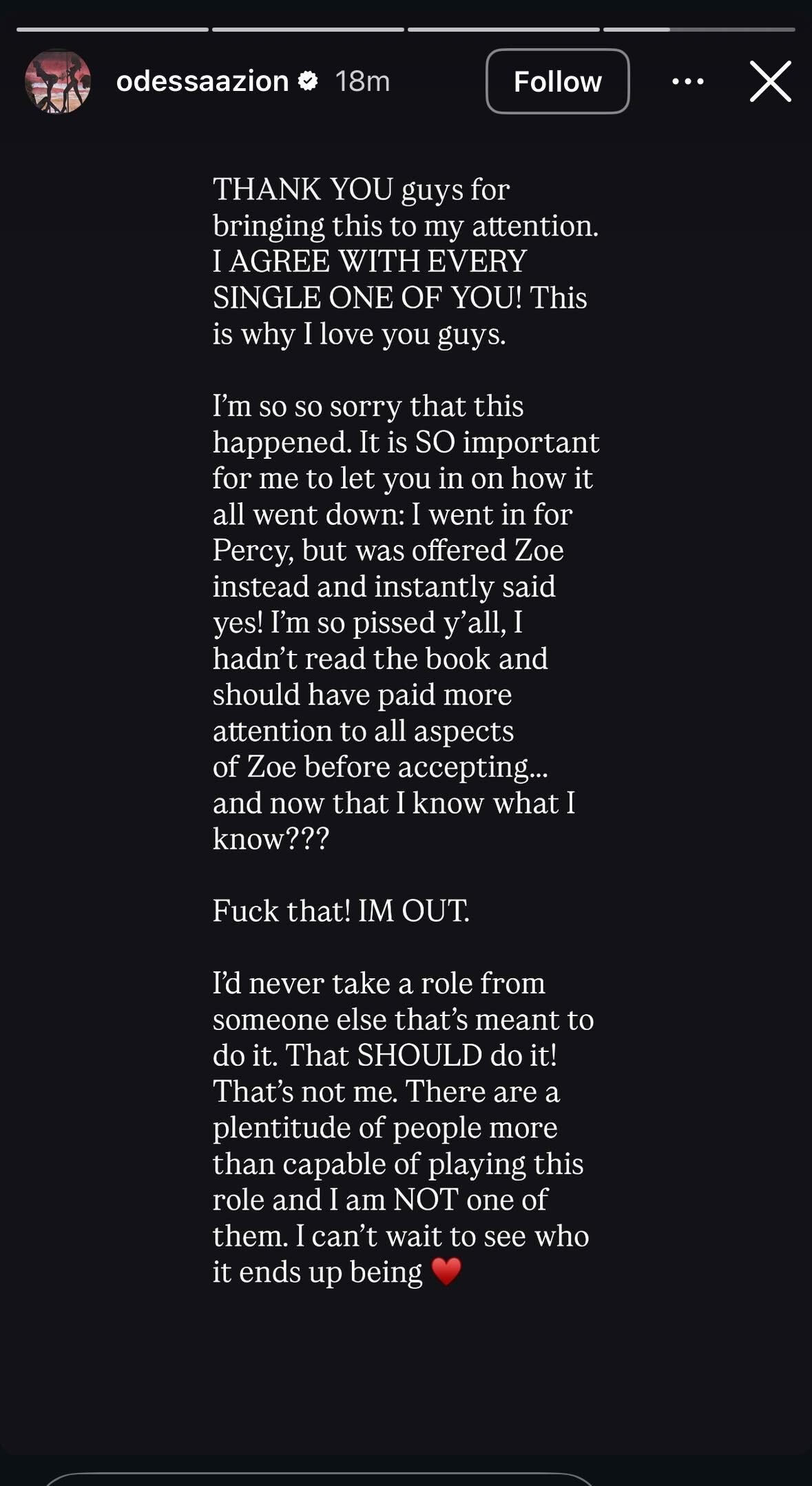
In an Instagram Story, A’zion addressed the criticism directly.
“Guys! I am with all of you and I am not doing this movie,” she wrote, adding that she appreciated people “bringing this to my attention.”
“I’m so sorry that this happened. I went in for Percy, but was offered Zoe instead and instantly said yes! I’m so pissed y’all, I hadn’t read the book and should have paid attention to all aspects of Zoe before accepting… and now that I know what I know? F**k that. I’m out!”
“I’d never take a role from someone else that’s meant to do it. That SHOULD do it! That’s not me. There are a plentitude of people more than capable of playing this role and I am not one of them. I can’t wait to see who it ends up being.”
When Latinos are being vilified, Hollywood’s casting “mistakes” hit louder
In a moment when the Latino community is vilified and persecuted amid government-sanctioned intimidation and violence, Hollywood’s “mishaps” read less like isolated errors and more like an industry reflex.
And the data keeps proving that reflex is structural.
Odessa A’zion is one story, but the USC numbers show a wider pattern
According to a new report from the USC Norman Lear Center, researchers Soraya Giaccardi Vargas, Ksenia A. Korobkova, Daa Weistein, and Erica L. Rosenthal lay out a daunting landscape.
While one in five Americans are Latino (or 68 million people,) the report notes the community faces “many challenges, including dehumanizing rhetoric and increased scrutiny.”
The researchers analyzed the top 20 U.S. broadcast programs with Latino characters in the 2024 to 2025 television season. They examined diversity, heritage, cultural specificity, and race centrality, meaning the degree to which race and ethnicity are central to a character’s storyline. They also tracked how these factors intersect with stereotypes.
What they found, while not surprising, still feels infuriating: Latino characters accounted for only 6% of all roles.
Odessa A’zion and the “one Latino friend” problem on TV
Fourteen of the 20 series in the sample featured four Latino characters or fewer, and half of these shows featured only one Latino character. Only six programs featured more than five Latino characters.
Similarly, even though shows set in Los Angeles featured about twice as many Latino characters as those set outside the city, representation still fell far below Latino population levels in both the United States and Los Angeles.
Cultural specificity remains rare, and the range stays narrow
The report also found a lack of diversity among Latino characters and that cultural specificity remained rare.
Researchers identified only one queer Latino character and three Latino characters with darker skin tones. Directors and screenwriters portrayed most Latinos as middle-class, underrepresenting both the working-class and the upper-class Latinos.
Out of 69 characters, only 18 had heritage tied to a specific Latin American nation, and most of those were Mexican.
Meanwhile, the vast majority of Latino characters 91% appeared in race-agnostic roles, where race and ethnicity are mentioned briefly or not at all. Only 9% appeared in race central roles, where race and ethnicity drive storylines or motivations.
Odessa A’zion and the stereotype pipeline
Then there is the part that still keeps showing up.
According to the report, criminality emerged as the most prominent theme. One in four Latino characters with evident professions were depicted as career criminals. Additionally, 11% were shown to be participating in drug trafficking, and 11% were part of a criminal organization. In those cases, the characters were typically depicted as unspecified Latinos.
Latino-led shows prove what happens when Latinos get to tell the story
On the other hand, the report found Latino-led shows offered more nuanced portrayals of pressing social issues, stronger cultural specificity, and more complex explorations of Latino identities. The report links this especially to shows that are also Latino-created.
“In these eight Latino-led shows, markers of cultural specificity like food, music, and cultural events were plentiful,” the report reads. “Five episodes specifically focused on depictions of quinceañeras, or celebrations of a girl’s 15th birthday, common in Latin America, particularly Mexico. Through this cultural event, characters wrestled with gender and generational dynamics in Latino families and the push-and-pull between tradition and identity.”
“Social issues in Latino-led shows were wide-ranging, including gentrification, displacement, colonization, immigration, gender roles, and family dynamics. Latino-led content tackled stereotypes with humor, and among these, Latino-created shows in particular more often centered the perspectives of Latino characters.”
Odessa A’zion is a symptom of an industry still refusing to align with reality
So yes, A’zion stepping down was the right move. Her response shows accountability and also how quickly the industry can put someone in a role that was never theirs to take in the first place.
Because the larger issue is not one actress making a bad call. It is an industry that still treats Latinos like a niche audience while relying on Latino attention, Latino dollars, and Latino cultural production to keep the machine moving.
And when the numbers keep shrinking, and stereotypes keep expanding, even a single miscast role stops feeling like a “debacle” and starts looking like the business model.