

Two Wives, One Familia: How This Latina’s LGBTQ+ Mexican Wedding Made Love the Only Rule
Natalie Ugalde, a first-gen Mexican American bride, planned an LGBTQ+ wedding rooted in cultura, faith, and family.
You can call it tradition, family, or “how we do things.” Natalie Ugalde calls it something else: a choice. A set of decisions you make out loud, in public, with witnesses. A decision to live inside your culture without asking permission to exist inside your own body.
Natalie is a first-generation Mexican American bride who planned what she describes as an LGBTQ+ wedding that blended “deep-rooted tradition with modern values of love and inclusivity.” She also planned it with a kind of clarity that feels rare right now. She decided early that the day would hold one truth, and it would hold it without apology: “Our love was equal to any other kind of love, no exceptions.”
Celebrating love starts by celebrating yourself
“My name is Natalie Ugalde, and I’m a first-generation Mexican American,” she told me, before she ever mentioned florals, venues, or the playlist.
When she talks about identity, she talks in inheritance and reclamation. “When I think about my identity as a queer Latina, some parts feel inherited, lo que me enseñó mi familia, and other parts I had to claim for myself, especially the ones that weren’t always included or accepted.”
She grew up in a “very traditional family” and says her grandparents raised her in a home where “femininity and masculinity lines were very bien marcadas.” She credits them for what grounds her: “the faith, the holidays, the celebrations, the music (especially when cleaning on weekend mornings), and of course the love of food and cooking.”
Then she tells you what she had to fight for. “What I really had to claim for myself was the freedom to show my masculinity while still being a woman,” she said. “I’ve always felt most comfortable presenting more masculine, desde chiquita, but there were so many moments where I was told not to embrace that side of me, that it wasn’t correct.”
That pressure shaped years of negotiation with herself. “That led to years of figuring myself out before I fully accepted who I am, a masculine woman, not a woman who wants to be a man, just a woman being auténtica and finally letting herself exist as her true self.”
It all started with an invisible string
Natalie met her partner the way “a lot of queer women meet now, online.” Then she starts stacking coincidences until they feel like evidence. “We had so many invisible connections we didn’t even realize at first,” she said. “It sounds cliché to talk about invisible string theory, but it’s hard not to believe in it when we were states away and still somehow always close, sharing mutuals, even being in the same city multiple times. Como que siempre estábamos cruzándonos sin saberlo.”
Still, she doesn’t frame the relationship as fate alone, but as discernment.
Natalie had been in a relationship for eight years before this one, and she says that history sharpened her instincts. “That taught me a lot about what I wanted long term and what I didn’t. So when this felt different, I trusted it.”
Then comes the turning point, and it has nothing to do with butterflies but with family.
“The real turning point for me was when I realized she was someone I could proudly introduce to my family,” Natalie said. “My family is very sacred to me, and it’s not something I’ve ever shared lightly, not even with the person I was with for eight years.”
She grew up watching a certain code of seriousness. “I grew up watching my tias and tios only bring one person around the family, their future spouse. I always knew I wanted to do the same.”
Her wife, she says, met that standard by being a partner in the fullest sense. “She’s kind, she’s personable, she treats me like a true partner, and she genuinely values my family connections and relationships, sometimes even more than I do.” And then, the detail that tells you everything: “Seeing how naturally she fit into that part of my life, and how much she respected it, that’s when I knew this wasn’t just love, it was something built to last.”
Coming out, Latino style: everyone knew, except her
Natalie describes her coming out with the kind of humour that shows up when you survive something, and you want to keep it from swallowing the room.
“Coming out for me is actually kind of funny because, honestly, everyone knew before I did. The only person who was surprised was me,” she said.
She didn’t grow up with language for it. “Growing up in our culture, it wasn’t something that was really talked about unless it came up in a negative way, so heterosexuality felt like the only option I knew existed.”
So she lived for a while inside a question she couldn’t yet name. “Even though I always felt different, I didn’t know why.” Later, exposure changed her internal map. “It wasn’t until I was exposed to the LGBTQ community that I really started to find myself. Once I did, everything just clicked, todo empezó a tener sentido.”
As she embraced masculinity as an adult, her grandmother struggled.
“My tias and tios showed me a lot of softness,” Natalie said, “but they’ve always been supportive of me.” And her mother’s stance landed with steadiness: “My mom has always been very open-minded and progressive, especially since she spent most of her life in the United States, so there was love there from the beginning.”
Natalie says she didn’t fully embrace living openly until her 30s. “There were never really big sit-down conversations because, again, everyone already knew; it felt like they were just waiting for me to catch up to myself.”
Then her grandparents gave her a sentence she plans to carry forever. “With time, my grandparents have come to accept it,” she said. “But what mattered most to me was what they said at my wedding. They shared kind words about just wanting me to be happy and to find a partner. That moment stayed with me, and it’s something I’ll carry for the rest of my life.”
Her LGBTQ+ wedding had one rule: show up with love, or do not show up
Natalie talks about boundaries the way people do when they set them early enough to protect joy.
“We decided very early on that our wedding was going to be a celebration of our love, and that our love was equal to any other kind of love, no exceptions,” she said. “That mindset made the boundaries clear from the start.”
Their biggest non-negotiable sounded simple, and it did the heavy lifting. “Only inviting people who accepted us together,” Natalie said. “We wanted the people closest to us, the ones who genuinely wanted to be there for us, not just for the event.”
The day itself ran without conflict, which Natalie calls luck without pretending it required no work. “We were lucky in that we didn’t have conflicts the day of our wedding,” she said, “but there were definitely a few awkward moments.”
And then she gives you the most human one: affection. “One of the biggest ones was just being openly affectionate in front of family. Kissing in front of them was new for both of us.”
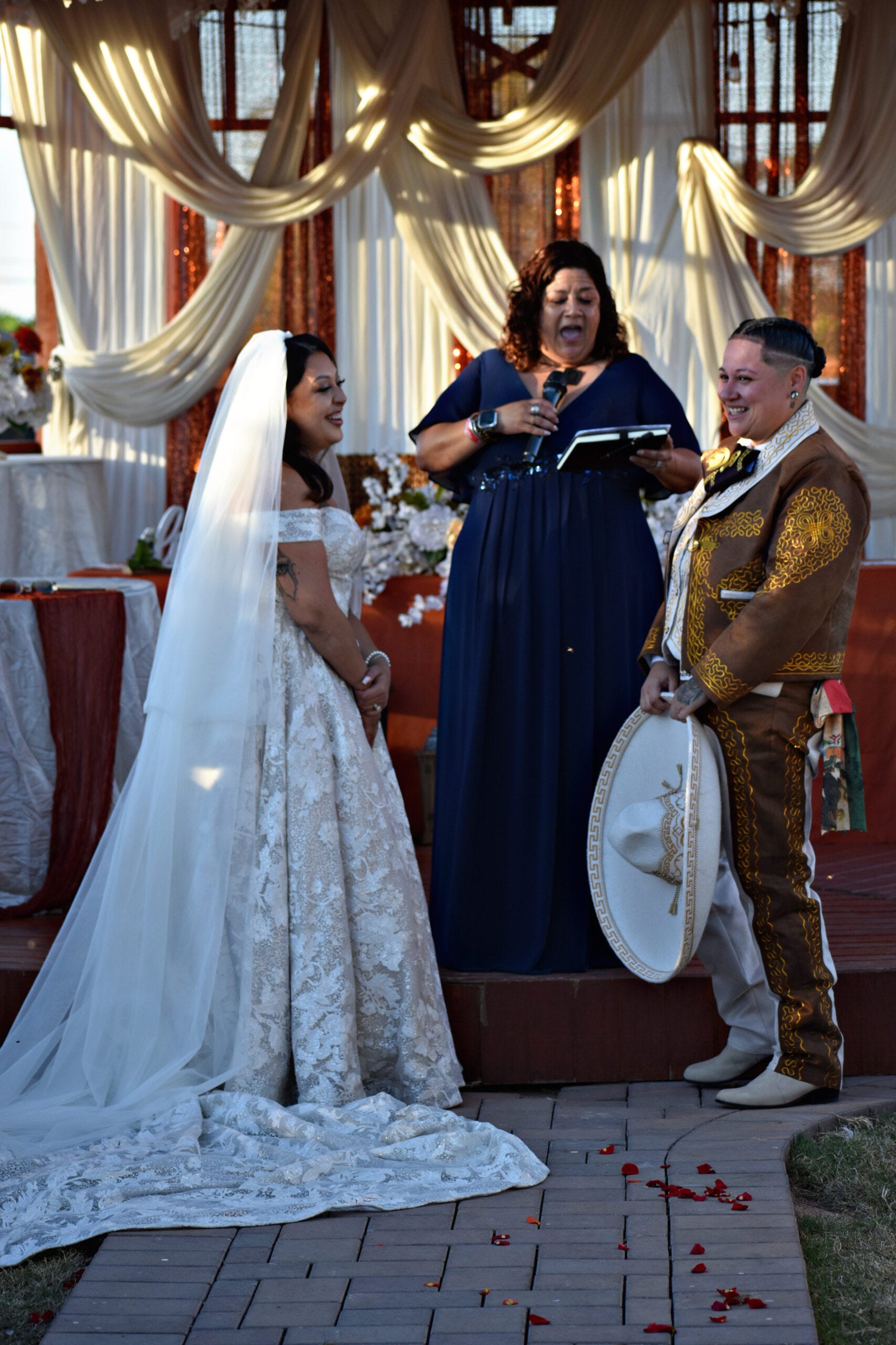
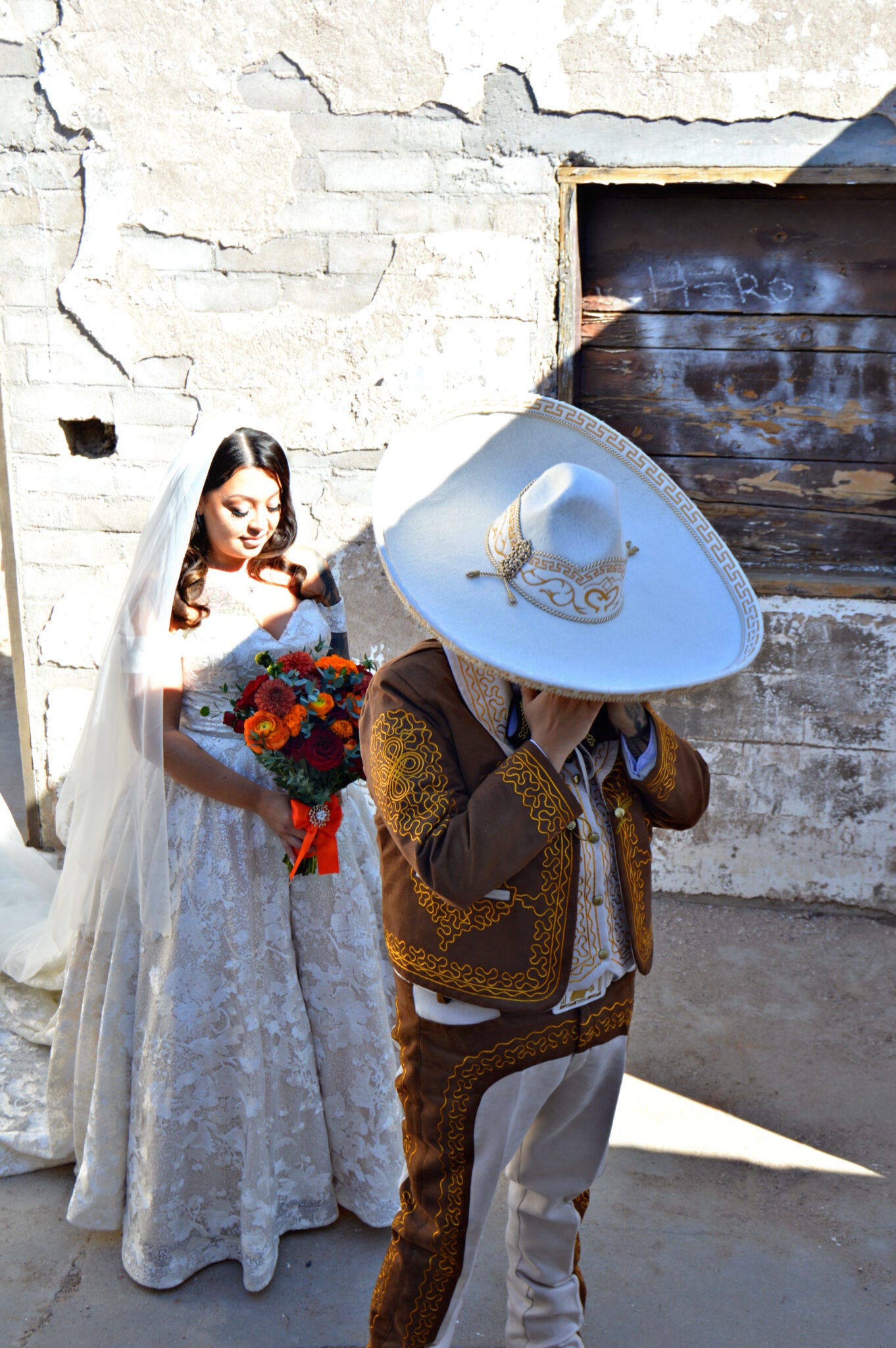
So she built a ritual out of shyness. “I used my charro sombrero to hide our kisses in a cute, shy way during photos and special moments. It became our little workaround, very us.”
Even the officiant's moment carried tenderness in the form of effort. “My tia was our officiant,” Natalie said, “and before the wedding, with only the best intentions, she wanted to make sure she got everything right. She asked about our pronouns and how we wanted to refer to each other, partners or wives.”
Natalie calls it awkward because it was a new language inside an old world. She also calls it care. “I was actually really grateful she cared enough to ask and wanted to be respectful.”
Where tradition hurts, and where it softens
Homophobia, for Natalie, didn’t arrive through one dramatic confrontation. It arrived through the slow drip of commentary, the refusal to see what stands right in front of you, the demand that queer people offer themselves in pieces.
“Homophobia showed up mostly through social media and strangers,” she said, explaining that online hate often targets her presentation as “the more masculine one.” “Even in our wedding posts, we’ve gotten negative comments about how I chose to dress, people comparing me to a man or assuming I wanted to be a man.”
She adds a detail that stings because it surprises people who still want to believe community equals safety. “I’ve even seen it come from people in the LGBTQ community, which is wild, and it always seems to center around my outfit choice in our wedding.”
Then she moves to the loss that carried real weight.
“The hardest part, though, was my wife’s grandmother not being at our wedding,” Natalie said. “She refused to accept it at first and still struggles with the idea of seeing her granddaughter marry a woman.”
Even after the ceremony, the boundary remained. “She only wanted to see pictures of my wife alone,” Natalie said, “which was hard.”
And then, the quieter cruelty: “A few other family members also showed quiet discontent in the beginning by not acknowledging our engagement.”
Natalie doesn’t romanticise it. She also doesn’t freeze people in their worst moments. “Over time, things have shifted,” she said. “Her grandmother, for example, has started to come around, even if she doesn’t fully agree, and for us, that’s a win.”
What she learned sits at the centre of so many Latino family stories right now. “It taught me a lot about how harm can hide inside tradition, how the ‘we love you but’ energy, the silence, the unspoken rules, can be just as painful as the loud rejection.”
Choosing an LGBTQ+ and traditional wedding meant reclaiming culture in public
Natalie chose a traditional wedding because tradition shaped her, and she refused to let it become the reason she disappeared.
“Traditions were really important to both of us since our grandparents had such a big influence on how we were raised,” she said. Choosing tradition symbolised “pride in our culture and reclaiming it, showing that we could fully participate in it, no matter our sexual orientation.”
From the start, she wanted “something traditional with our own modern twists,” and she describes how the vision expanded as they planned.
Clothing became its own language. “It took me some time to figure out what I wanted to wear,” she said. “I wanted to be myself and show my masculinity, but a modern suit never felt right.”
So she went backward, toward the person who taught her how to stand.
“I’ve always admired my grandfather,” Natalie said. “His nickname in Mexico is Charro, and he’s the reason I have such a love for animals and the ranch lifestyle.”
She explored charro-themed looks, then edited them until they felt like her. “Most looked too much like Mariachi outfits,” she said. She ended up choosing “a less formal, more traditional option made of wool and cotton that felt true to me.”
Her wife’s dress arrived as its own quiet alignment. “I didn’t see her dress until her first look,” Natalie said, “and she picked one she loved, not realizing it went perfectly with our theme.”
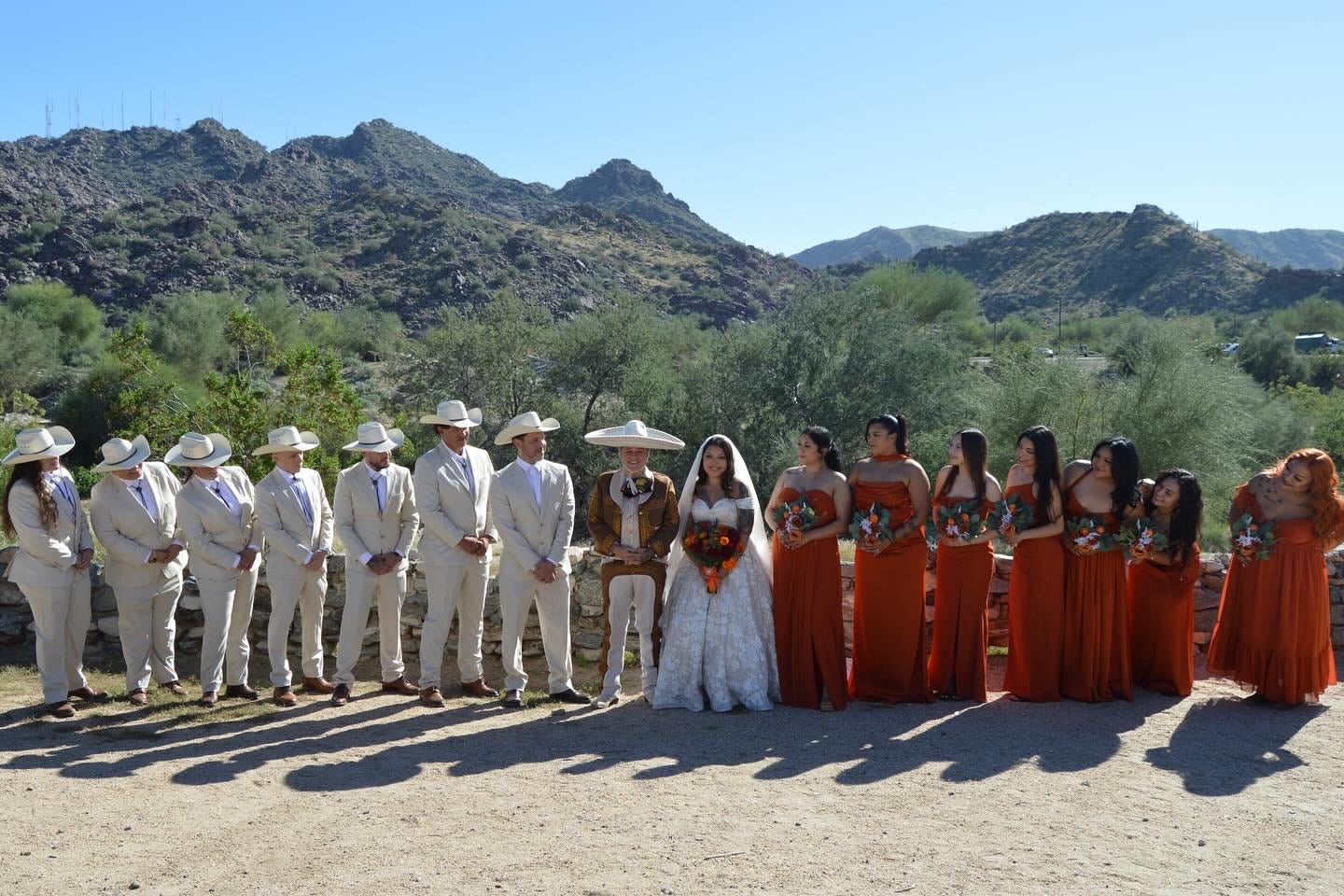
They kept traditions that felt like home: “the ramo and liga toss, and our full bridal party, hasta con los niños.” They also reimagined what the church would have dictated. “We had to reimagine the ceremony since we couldn’t marry through the church,” she said. They kept it “short, simple, and sweet,” and in a later detail, Natalie added that they “included a violinist.”
“We added a drag performance during our dinner reception for entertainment, and everyone loved it,” she said, “even participating in the fun through their act and by giving out dollar bills.”
Natalie’s emotional reason lands quietly, then stays. “Holding onto the traditions helped heal a part of me that had grown up wanting to experience what I saw my tias and tios experience.”
A political decision, even before the vows
In Natalie’s telling, politics did not hover at the edge of the day. Politics sits in the practical choices queer couples make when they know how quickly rights can become debates.
“With today’s political climate, I wanted our wedding to be a public act of defiance and pride,” she said.
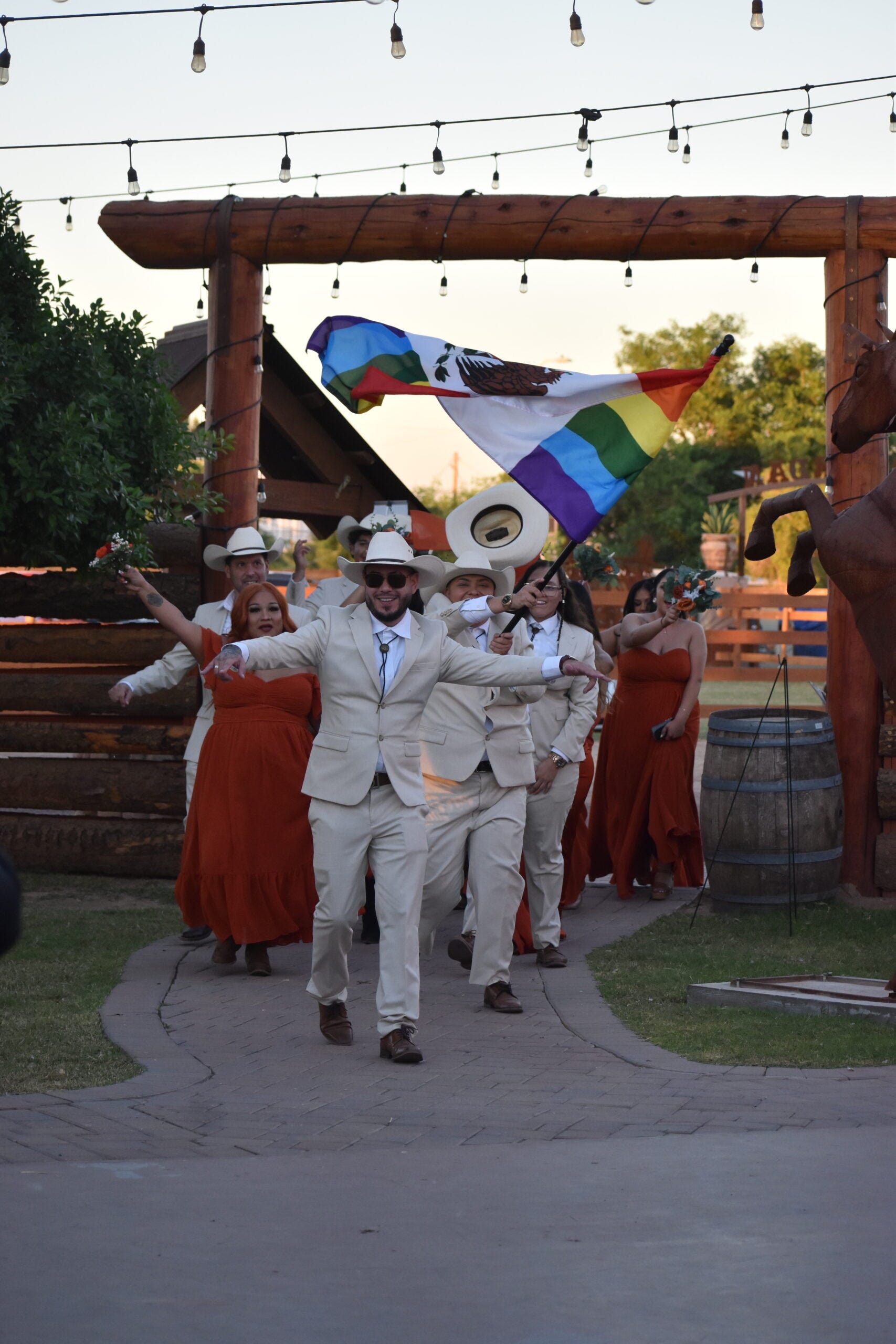
Their entrance carried that energy. “During our entrances, our wedding party came out to the song FDT by YG, carrying a giant LGBTQ Mexican flag.” Natalie calls it “a HUGE moment of pride” because pride didn’t always come easily. “Pride is not something I always had, even after realizing I was attracted to women,” she said. “I carried shame that came from ancestral pasts for a very long time.”
She says fear did not dominate their planning. Pressure did.
“We never felt fear in our wedding planning or wedding moments, but we definitely felt the pressure of knowing our rights were at risk once our current president was elected back in office.”
So they moved with caution that many couples recognise. “We actually officiated our wedding through the court a year prior to our actual ceremony, por si acaso.” They kept it private until the day itself, when they reframed the celebration in front of their families. “We kept it a secret until our actual wedding ceremony, where we announced to everyone that they were celebrating our 1st anniversary.”
Looking back, she hopes the ceremony taught one lesson: time changes, and families can choose to change with it.
“I hope it showed that the world isn’t what it used to be,” Natalie said. “Many people in the LGBTQ community no longer want to hide, and we want to be accepted for who we are.”
Then she offers the line that reads like a vow to the entire room. “Love is not a crime; love is the purest emotion humans can have.”
And she brings it home to identity across time, the way diaspora kids always do, holding past and present in the same hands. “I also hope it showed the LGBTQ and Latinx community that you can have pride in your past, your present, and your future.”
“At the end of the day,” she added, “we only get one life, and we should love each other for who we are, as long as it comes from genuinely good hearts and intentions.”