Inside Trump’s ‘Hall of Shame’: Women Journalists on the Front Line of a Fascist Strategy
If there are two things Donald Trump cannot stand, it is women and the media, in that order. Now the President has fused those obsessions into official policy by turning the White House website into a public pillory.
The administration has created a “Hall of Shame” that lives on WhiteHouse.gov. On its face, it is a database of “media offenders.” In practice, it is a state-run enemies list aimed at delegitimizing reporters who hold power to account, with a particular fixation on women.
And that is where the story stops being petty and starts looking like a blueprint.
Trump’s ‘Hall of Shame’ turns the White House site into a bully pulpit
The White House recently launched a “Hall of Shame” page to target and shame media outlets and call out journalists who have criticized the government. According to the site, the list compiles the names of outlets and people who have “misrepresented” President Donald Trump.
In an attempt to control the narrative, the official White House site selects a “Media Offender of the Week,” describes the alleged offense, often “misrepresentation,” and then tries to rewrite the truth in its own words.
According to the Washington Post, the page now shows a database of news articles from publications like CBS News, CNN, and MSNBC, and accuses them of “bias,” “lies,” and “left-wing lunacy.” The White House also invites visitors to sign up for a newsletter that promises weekly updates on the “truth,” the Post reported.
The page accuses outlets of allegedly misreporting Trump’s actions, including his comments about six Democratic members of Congress. The initiative also categorizes individual reporters’ work under offenses such as “bias,” “lie,” and “left-wing lunacy,” according to the outlet.
Seth Stern, director of advocacy at the Freedom of the Press Foundation, told the Washington Post that “People understand the obvious conflict inherent in a presidential administration appointing itself the arbiter of media bias, and I expect that after the initial wave of publicity, few Americans will be paying attention to this latest stunt. The gimmick is wearing thin.” He also said that Trump’s real issue is with “journalists not flattering him and regurgitating his lies.”
Inside the ‘Hall of Shame’ and who Trump wants you to distrust
The “Hall of Shame” does not stop at vague attacks on institutions. It names names. The page displays a database of articles, listing both the publication and the reporter involved.
For example, The Washington Post appears as a top “offender” over coverage of the U.S. Coast Guard’s brief decision to stop classifying swastikas and nooses as hate symbols. That story is tagged as a “Lie” and co-authored by reporters Michelle Boorstein and Tara Copp.
The same page lists Associated Press reporters Ali Swenson and Lauran Neergaard under “False Claim, Lie, Malpractice” for a story on Trump’s claims about Tylenol and vaccines. It tags ABC’s Ana Navarro with “Left-wing lunacy” over comments about “Alligator Alcatraz.” It flags CBS News reporter Gabriela Vidal for “Bias” and “Omission of context” in a story that described a deported man with two dozen arrests as a “Colorado Grandfather,” according to the IBTimes.
On paper, the White House argues that “every order President Trump has issued has been lawful” and claims that reporting which suggests otherwise misrepresents his actions, the Washington Post noted. In practice, the “Hall of Shame” reads like a searchable hit list that tells Trump’s base exactly which bylines to discredit.
Based on the full list of 47 reporters provided, 22 are female, or roughly 47 percent. When institutional listings cite staff as a group, such as “The BBC Staff,” the focus on individual women for specific offenses stands out even more, IBTimes reported.
Similarly, on his “Hall of Shame,” of the 47 individual journalists named, eight are Latino.
Female journalists pay the highest price for Trump’s attacks
Donald Trump has never hidden his repudiation and disdain towards women. However, he turns the volume up when it comes to female journalists.
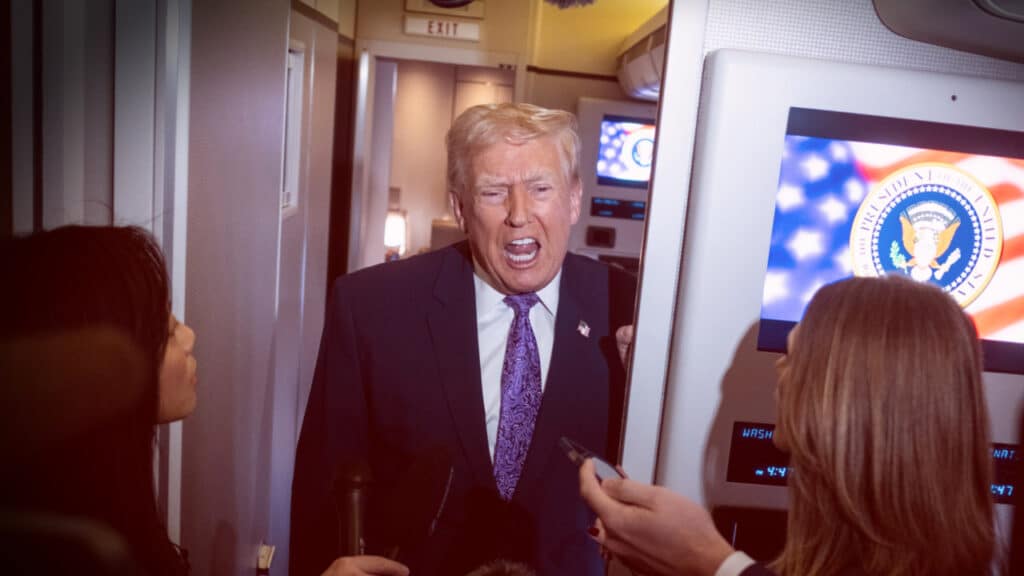
In recent weeks alone, when a Bloomberg reporter asked him a question aboard Air Force One, he responded, “Quiet, piggy.” At a later event, he called an ABC reporter “a terrible person and a terrible reporter” and dismissed her network as “fake news,” according to the Washington Post. He also described a New York Times reporter as “a third-rate reporter who is ugly, both inside and out” in a Truth Social post, and he called a CBS News reporter “a stupid person” after she asked about vetting of Afghan refugees.
White House press secretary Karoline Leavitt defended the “Quiet, piggy” remark at a briefing and said that the President is only confronting journalists directly, according to the Washington Post. That defence ignored the gendered nature of his most high-profile insults. Many of them fixate on women’s looks and intelligence.
The International Business Times notes that the female reporters singled out on the site often covered immigration, health, and policy disputes. Those are precisely the beats where journalists scrutinize the human impact of Trump’s policies and rhetoric.
When you zoom out, a pattern emerges. Trump is not only labelling reporters as biased. He is encouraging his supporters to see specific women as liars, enemies, and punchlines.
From fascist blueprints to today’s ‘Hall of Shame’
If you feel shocked that the U.S. government now hosts a “Hall of Shame” for journalists, history has a few reminders. This script has played out before.
Journalism has long been perceived as a check on power in democratic governments. For fascist and authoritarian projects, an independent press is a threat. Under an autocratic government, there is no independent media. There is only propaganda. In a time when many people skim headlines and scroll social feeds, propaganda has an easier job.
Historical fascist strategies against the press followed a familiar arc. Leaders demonized and scapegoated the media, calling reporters “enemies of the people” and accusing them of spreading lies that endangered the nation. They created central bodies to control communication, such as the Nazi Ministry of Public Enlightenment and Propaganda, or Italy’s Ministry of Popular Culture, which managed the “literary and intellectual environment.” Legal tools did the rest.
In fact, Hitler had the Nazi “Editor’s Law” (Schriftleitergesetz) that in 1933 required journalists to be licensed as public servants dependent on the regime’s goodwill. In both Italy and Germany, thousands of journalists were imprisoned, sent to concentration camps, or, in the best-case scenario, forced to close their publications. Censorship, confiscation of newspapers, and constant disinformation created a state of unreality in which the leader’s word replaced shared facts.
The “Strategies Against Media and Shaming Journalists” that scholars outline today sound unsettlingly familiar: demonization, legal suppression, censorship, propaganda, and the self-censorship that follows when people fear punishment. The goal is always the same. Delegitimize the press. Sap its power. Then absorb what is left into a loyal propaganda machine.
Latin America’s scars show what comes after the attacks
You do not need to look only at Europe for proof. Latin America carries its own scars.
Most recently in history, journalists in Latin America during the 1960s and 70s were tortured and disappeared under dictatorship rule, regimes installed with the help of the U.S., by the way. And being a journalist in places like Mexico or Colombia is still one of the most dangerous jobs you can have.
Those governments also started with narratives about “biased” reporters, “subversive” outlets, and “enemies within.” Then came legal clampdowns, media blackouts, and, eventually, violence. Once a leader convinces enough people that reporters are the problem, it becomes easier to punish them in public and in private.
This ‘Hall of Shame’ is a warning siren, not a joke
Trump’s defenders will say this is just politics. A stunt. Another round in his long feud with “fake news.” Seth Stern already called it a gimmick and said, “The gimmick is wearing thin.” That may be true in Washington media circles.
For women in the profession, especially women of color, the stakes feel different. When the President tags you on an official White House “Hall of Shame” and calls you “piggy,” “a terrible reporter,” or “ugly, both inside and out,” the threat does not end when you close your laptop. It follows you into your mentions, your inbox, your newsroom, and your life.
And for anyone who cares about a free press, the pattern is clear. You cannot separate the “Hall of Shame” from the broader fascist playbook that treats independent journalism as an obstacle to be mocked, weakened, and replaced.
So, now that the U.S. has its own “Hall of Shame,” do you still think democracy is safe?