“This Would Be a Health Crisis If Men Had It”: Why Menopause and Perimenopause Can’t Be Ignored Any Longer
For decades, perimenopause and menopause lived in the shadows of women’s health. Doctors minimized it, research underfunded it, and workplaces ignored it. Then Halle Berry stood on a public stage and said the quiet part out loud.
“If men had a medical condition that disrupted their sleep, brain function and sex life, we’d be calling that a health crisis on par with Covid, and the whole world would shut down,” Berry said at The New York Times DealBook Summit in December.
That moment landed because it named what millions already know. Menopause and perimenopause are not fringe experiences. They shape careers, relationships, mental health, and economic stability. And now, celebrities are forcing the issue into public view.
Halle Berry made menopause and perimenopause impossible to ignore
Berry’s remarks came as she criticized California Governor Gavin Newsom for vetoing the Menopause Care Equity Act, which would have expanded insurance coverage for menopause and perimenopause treatments and required physician education, according to Variety.
“With the way he’s overlooked women, half the population, by devaluing us in midlife, he probably should not be the next president,” Berry said at the summit.
She framed menopause as a societal issue, not a private inconvenience. “When women are struggling silently through perimenopause and menopause, trying to hold their families, careers, relationships and communities together, it doesn’t just affect women,” she said. “It affects every household, the workplace. It affects the economy.”
Berry cited data showing that one in six women leave the workforce due to menopausal symptoms. She closed her speech with a line that became a rallying cry. “At this stage of my life, I have zero fucks left to give.”
Why menopause and perimenopause still get dismissed
Part of the problem sits in how menopause has been framed for decades. According to Yale University, menopause was long treated as a sudden biological event instead of a gradual transition that can begin up to ten years earlier.
“You were supposed to go to bed one night premenopausal and wake up the next morning postmenopausal,” Dr. Mary Jane Minkin told Yale. “Menopause is easy. It’s perimenopause that’s tricky.”
Perimenopause often begins in a woman’s 40s, sometimes earlier, and brings unpredictable hormonal fluctuations. According to Yale, symptoms extend far beyond hot flashes and night sweats. They include brain fog, depression, insomnia, cardiovascular risk, bone loss, and cognitive changes.
Yet medical training has failed to keep pace. A 2023 survey cited by Yale found that while more than 90 percent of OB-GYN residency directors agree menopause education is necessary, fewer than one-third offer standardized training.
Alyssa Milano is pushing the story past celebrity soundbites
If Berry brought urgency, Alyssa Milano brought structure. Milano and Jeannie Mai are executive producing BALANCE: A Perimenopause Journey, a four-part docuseries premiering in January.
“Women shouldn’t have to suffer in confusion and shame,” Milano told People exclusively. “With this docuseries, we’re reclaiming our narratives, pushing for research, and demanding a healthcare system that treats women with respect and equity.”
The series centers women describing symptoms often dismissed as exaggeration. Low sex drive, depression, anxiety, brain fog, insomnia… “It’s just hot flashes and night sweats is the biggest crock of shit that’s ever been delivered to people,” a voiceover states in the trailer.
Experts including Dr. Mary Claire Haver and Dr. Sharon Malone explain why hormone therapy has been misunderstood and why early treatment matters.
Menopause and perimenopause start earlier than we were told
Research continues to dismantle the myth that menopause begins in the 50s. A University of Virginia study conducted with the Flo app found that more than half of women aged 30 to 35 reported moderate to severe menopause-related symptoms, according to UVA Health.
Despite this, most women do not seek treatment until their mid-50s.
“Physical and emotional symptoms associated with perimenopause are understudied and often dismissed by physicians,” said Dr. Jennifer Payne of UVA Health. The study found psychological symptoms like anxiety and depression often appear before physical ones.
The disconnect leaves women cycling through specialists without answers, while the hormonal root cause goes untreated.
Hormone therapy is still haunted by bad science
Hormone replacement therapy remains one of the most effective treatments for peri- and postmenopausal symptoms, according to Yale and The Menopause Society. Yet its reputation suffered after a flawed 2002 Women’s Health Initiative study linked hormone therapy to increased cancer and cardiovascular risk.
Subsequent research showed the study focused on older women well past menopause and used outdated delivery methods. Still, prescriptions dropped nearly 50 percent within months.
New data presented by The Menopause Society in 2025 suggests estrogen therapy started during perimenopause carries no significantly higher risk of breast cancer, heart attack, or stroke, according to a large-scale analysis of more than 120 million patient records.
“The findings suggest lower risk and potentially greater benefit of estrogen-based therapy when started in perimenopause,” said Dr. Stephanie Faubion, medical director of The Menopause Society.
The funding gap behind menopause and perimenopause
Despite affecting half of humanity, menopause research remains severely underfunded. According to Nature, the NIH allocated $56 million to menopause research in 2023, increasing slightly to $58 million in 2024.
For comparison, Nature notes that conditions affecting men receive significantly more funding across aging research. Many major funders still do not track menopause as a dedicated research category.
“That something experienced by half of humanity is not more studied is little short of scandalous,” Nature wrote.
There are signs of progress. The NIH established a menopause research category in 2023. Melinda French Gates’ Pivotal Ventures launched a $250 million women’s health funding initiative. Still, menopause remains absent from many global funding priorities.
When public voices force medical change
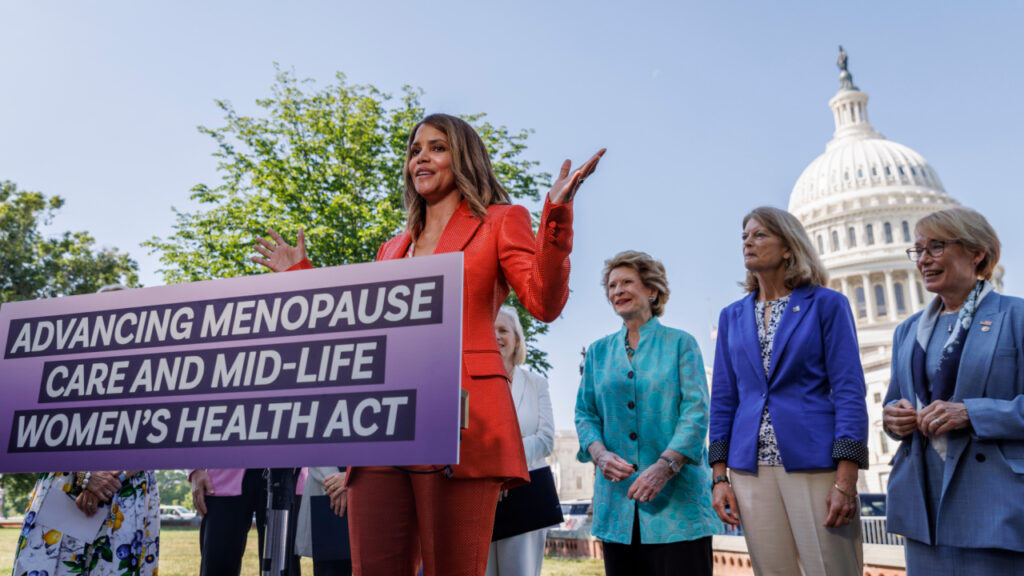
Berry shouting “I’m in menopause” on Capitol Hill, Milano producing a docuseries, and researchers publishing long-overdue data point to the same truth: silence protected no one.
As Yale notes, by 2030 more than one billion women globally will be in menopause. The cost of ignoring menopause and perimenopause shows up in lost labor, misdiagnosed mental health issues, and preventable disease.
“If a woman understands her physiology, she’ll do much better in the long run,” Dr. Minkin told Yale.
For the first time in decades, understanding is starting to catch up. And this time, women are refusing to whisper.